Last Day Left! Apply before 17th October 2026 to enroll in the final batch. Call now: 9112207207
MITSDE Career Accelerator Program in
AI-Enabled Lean Six Sigma Green Belt + Black Belt Training and Certificate





About the Program
The AI-Enabled Lean Six Sigma Green Belt + Lean Six Sigma Black Belt Training and Certificate is an advanced intermediate-level program that combines the proven Lean Six Sigma methodology with the power of Artificial Intelligence (AI) to drive smarter, faster and more effective process improvements.
The program provides comprehensive knowledge of Lean Six Sigma principles, the DMAIC methodology, statistical analysis and industry-standard quality tools while introducing AI-powered techniques for data analysis, root cause identification, process optimization, predictive insights and decision-making.
After completion of the AI-Integrated Lean Six Sigma Green Belt learning, the Black Belt learning begins with a focus on advanced methodologies including DMAIC and DFSS to solve complex business problems.
Participants learn statistical tools such as hypothesis testing, ANOVA, Regression, DOE and MSA for data-driven decisions and develop the ability to select, prioritize and lead high-impact improvement projects.
The program also focuses on Lean implementation, benchmarking and strategic performance management to drive sustainable business excellence.
Participants will develop skills to lead improvement projects, analyze complex business data, eliminate waste, reduce process variation and implement sustainable solutions using Lean Six Sigma and AI-enabled tools.
The program also equips professionals to leverage AI for enhanced productivity, automation and continuous improvement across manufacturing, service, healthcare, IT and other industries.
Upon successful completion, participants will be prepared to lead cross-functional improvement initiatives under the guidance of Lean Six Sigma Black Belts or Master Black Belts while applying AI-driven approaches to solve real-world business challenges and accelerate organizational excellence.
Certification Accreditations
Asian Institute of Quality Management is accredited institute by The Council for Six Sigma Certification (CSSC-USA) . The CSSC accreditation reflects global standards of excellence in Lean Six Sigma education. This internationally recognized credential validates your knowledge, strengthens your professional credibility and enhances your career opportunities across industries. Employers worldwide value the CSSC certification as a benchmark of quality, competence and practical problem-solving expertise. Earn a certification that is respected globally and recognized for its commitment to operational excellence.
Why Choose the Combo Lean Six Sigma Course Training & Certification?
In today's rapidly evolving and competitive business environment, organizations need professionals who can lead process improvement, solve complex business challenges and deliver measurable results.
This program combines advanced Lean Six Sigma methodologies, statistical tools, leadership capabilities and AI-powered solutions to drive operational excellence and data-driven decision-making.
By enrolling in this program, you will:
- Develop advanced expertise in the globally recognized CSSC-USA Lean Six Sigma DMAIC and DFSS methodologies.
- Master advanced statistical analysis, data-driven decision-making and problem-solving techniques.
- Learn to integrate AI-powered tools into process improvement, data analysis, reporting and decision support.
- Lead cross-functional improvement projects that deliver measurable improvements in quality, productivity, cost and customer satisfaction.
- Reduce process waste and variation while optimizing operational performance and efficiency.
- Apply advanced Lean Six Sigma and AI-enabled tools to solve complex organizational problems.
- Develop strong leadership, analytical, strategic thinking and project management capabilities.
- Mentor and guide Green Belts and project teams to achieve successful project outcomes.
- Gain practical experience through real-world case studies, simulations, exercises and project-based learning.
- Enhance your career opportunities across Manufacturing, Quality, Operations, Supply Chain, Healthcare, IT, Banking and Service industries.
- Earn an internationally recognized Lean Six Sigma Black Belt certification that validates your process improvement expertise.
- Build future-ready skills to lead continuous improvement and remain competitive in the age of AI and digital transformation.
What Makes This AI-Enabled Lean Six Sigma Program Stand Out?
- AI-Integrated Lean Six Sigma Learning (Green Belt)
- Globally Recognized Certificates
- Real-World Project Experience
- Expert Industry Trainers
- Practical Data Analysis & AI Tools
- Industry-Relevant Case Studies
- Comprehensive Learning Resources
- Career Advancement & Higher Employability
- Live Interactive Virtual Sessions
- Job-Ready Continuous Improvement Skills
Curriculum
AI-Integrated Lean Six Sigma Green Belt - Training Content
- Quality Defined - VOC, CTQ, KANO Model
- The Process Approach: CTPs
- Improving Effectiveness & Efficiency of Processes
- Evolution of The Quality Function
- Appraisal & Prevention in Processes using ICD & RCO Preventions
- Detection Pokayoke, Occurrence Pokayoke
- Root Cause Analysis (RCA)
- Correction, Corrective Action, Preventive Action
- Goals of Lean Six Sigma
- Team Formation for Lean Six Sigma Projects
- Cross-Functional Cooperation / Boundary-less Collaboration
Selecting Organization's Pain Areas for implementing Lean Six Sigma Projects
Route for achievement of SQCD Goals to deliver VALUE to organization
- DPU & DPMO - Calculating Process Capability / Sigma Level
- Cost of Good Quality Vs Cost of Poor Quality - Impact On Sigma Level Of A Process
- Phil Crosby’s Findings
- Motorola’s journey from 3.4 to 6.0 sigma (SELF READING)
- Lean Six Sigma
- Basic principles
- Cultural changes required while implementing Lean Six Sigma (SELF-READING)
- Understanding Variation in Processes
- Introduction to Descriptive Statistics
- Central Tendency (mean - median - mode)
- Spread (range - standard deviation)
- Use of Excel ‘data analysis’ tools for descriptive statistics
- Presence of Assignable Cause Variation and Non-Assignable Cause
- Interpreting Variation in Processes using Descriptive Statistics
- Continual Improvement Vs. Breakthrough Improvement
- Seven Tools of Quality
- Flowchart / Process Map
- Check-sheet
- Pareto Chart
- Histogram
- Fishbone
- Scatter Plot / Correlation Coefficient
- Control Charts
- Use of SPC (Statistical Process Control)
- Calculating Process Capability Cp, Cpk
- Breakthrough Improvement and Continual Improvement in SPC
- Exercises linked to above concepts
- Seven types of Control Charts and their interpretation
- Exercises linked to above charts
- DMAIC Methodology for Implementing Lean Six Sigma Projects to Achieve Process Excellence
- D - Define Phase
- M - Measure Phase
- A - Analyze Phase
- I - Improve Phase
- C - Control Phase
Quantitative exercises using Excel data analytics
DMAIC Framework & DMAIC Case Study - Defect Reduction (Workbook)
- Failure Mode & Effect Analysis (FMEA)
- Use of Lean Tools in Lean Six Sigma
- Value Stream Process Mapping
- AI Applications in Six Sigma - Use Cases
Lean Six Sigma Black Belt - Training Content
- GB Revision Quiz for entry to GB Level
- Design For Six Sigma (DFSS)
- Define - Measure - Analyze - Improve - Control
- Pugh Matrix
- QFD
- Voice of Customer
- Ethnography
- Kano Model
- CT Matrix
- DMADV Overview
- Design Of Experiments (DOE)
- More on BB Projects
- SIRPORC Diagram
- Selecting The Right Projects
- Pareto Priority Index
- Template For Project Charter - Lean Six Sigma Black Belt Project
- The DMAIC Process - Choice Of Tools
- Other Templates
- Descriptive Statistics
- Data Distribution, Skewness, Kurtosis
- Box & Whisker Plots
- Inferential Statistics
- Confidence Intervals
- Hypothesis Testing (z-test / t-test for one population mean)
- Hypothesis Testing (z-test / t-test for two population means)
- ANOVA - Analysis of Variances
- Regression Analysis
- Six Sigma - A Complete Management System
- Lean Tools Implementation
- Balanced Scorecard
- Benchmarking Techniques
- Measurement System Analysis (MSA)
Training and Certification Fees
Trainer Profile

International Trainer & Consultant for Lean Six Sigma, Kaizen-Lean Management, 3P Events, TQM, TPM, Manufacturing Excellence, Project Management, Business Analytics, SPC, KPI Management, 5 Core Tools, Business Strategy, Certifications for implementation and auditing of various ISO Management Systems, Improving Personal & Professional Productivity. Read More

Mrs. Kawaljit Singh is an IT professional with over 37 years’ work experience in the field of Quality Management and Manufacturing / Operational Excellence working with a variety of industries in the manufacturing and services sectors. Read More
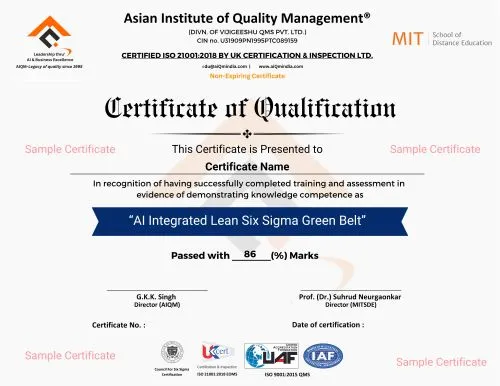
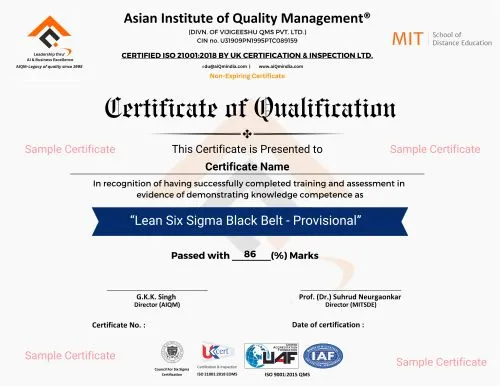
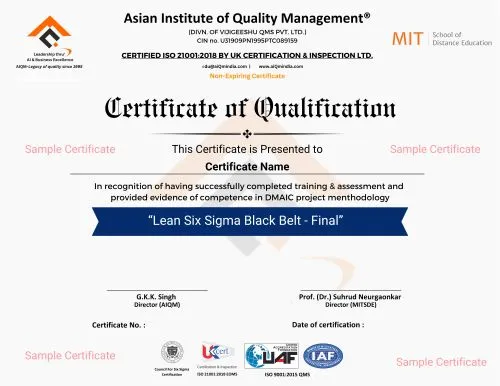
Program Certification
Why This Course Is Right for You—Now, Not Later
-
1. Stay Ahead with AI
Learn AI-powered process improvement before it becomes an industry standard. -
2. Grow Your Career Faster
Build in-demand skills that employers actively seek. -
3. Deliver Results Immediately
Apply what you learn to improve quality, productivity and costs. -
4. Stand Out from the Competition
Earn a globally recognized certification that strengthens your profile. -
5. Future-Proof Your Skills
Prepare for leadership roles in an AI-driven business environment.
Frequently Asked Questions (FAQs)
Lean Six Sigma Green Belt + Black Belt Combo Certification is an integrated professional development program designed to build expertise in Lean Six Sigma from foundational to advanced levels.
The program covers the complete DMAIC methodology, Lean tools, statistical techniques, process improvement methodologies, and advanced problem-solving techniques.
At the Black Belt level, participants also develop expertise in Design for Six Sigma (DFSS), advanced statistical tools, Hypothesis Testing, ANOVA, Regression Analysis, Design of Experiments (DOE), and Measurement System Analysis (MSA).
The program equips participants with the knowledge and practical skills required to lead, manage, and mentor Lean Six Sigma improvement projects across business and manufacturing environments.
The program is suitable for professionals, managers, engineers, quality and operations professionals, process improvement practitioners, consultants, team leaders, and individuals seeking to build expertise in Lean Six Sigma.
It is ideal for those who want to develop skills from foundational to advanced levels and gain the capability to lead, manage, and mentor process improvement projects across manufacturing, service, healthcare, supply chain, IT, and other business environments.
There is no specific educational qualification required to enroll in the program.
The course is open to graduates, diploma holders, working professionals, engineers, managers, and individuals from any industry who are interested in process improvement and operational excellence.
AIQM is accredited by the Council for Six Sigma Certification (CSSC), USA , one of the leading accreditation bodies for Six Sigma certification.
This accreditation strengthens the credibility and global recognition of AIQM’s Lean Six Sigma certifications.
The program primarily follows the DMAIC & DFSS Methodology along with advanced Lean Six Sigma tools, statistical analysis, process improvement techniques, project management, and problem-solving methodologies.
No, prior Lean Six Sigma knowledge is not required for the Combo Certification.
The program starts with the fundamentals of Lean Six Sigma and progressively covers Green Belt concepts before advancing to Black Belt-level methodologies and statistical tools.
It is suitable for both beginners and professionals with prior process improvement experience.
The Combo Course provides a structured learning path from foundational to advanced Lean Six Sigma expertise.
Participants develop comprehensive knowledge of Lean Six Sigma and the DMAIC methodology, learn practical Lean, quality, and process improvement tools, and build advanced skills in Hypothesis Testing, ANOVA, Regression, DOE, MSA, and Design for Six Sigma (DFSS).
The program enhances participants’ ability to solve complex business problems, lead and mentor improvement projects, and drive measurable improvements in quality, cost, productivity, and process performance, while earning both Green Belt and Black Belt certifications through a single integrated learning pathway.
During the Lean Six Sigma Black Belt certification, candidates are required to submit a project as part of the certification process.
AIQM recommends implementing a live project to demonstrate the practical application of Lean Six Sigma methodologies.
However, if a candidate does not have the opportunity to implement a live project, a simulated project may be submitted to complete the certification process.
Yes. The training program is designed to help professionals lead and implement improvement projects using a structured DMAIC/DFSS approach.
Participants can apply the methodology to real or simulated business improvement projects.
The Lean Six Sigma combo course is conducted through live sessions.
The course duration is
7 Months (2 Months Session & Exam + 3 Months Project work)
(56 hours for Training (both GB & BB courses) + 2 Hours Examination for each certificate).
The trainings will be conducted on weekends (Sat-Sun) as evening classes from 6:00 pm to 9:30 pm.
The training sessions will be recorded and uploaded to the LMS account.
Participants can access the recordings through their LMS account for the specified access period.
Yes. Candidates are required to successfully complete the Black Belt examination with a minimum score of 50% to qualify for the certification.
On successfully completing the examination, the candidate will receive the exam certification.
The project needs to be submitted after completion of the LSS Black Belt examination.
On successful submission of the LSS Black Belt Project, the candidate will receive the certification for project completion (soft copy and hard copy).
Yes. Both the Lean Six Sigma Green Belt and Black Belt certificates offered by AIQM are accredited by the Council for Six Sigma Certification (CSSC-USA) and carry international recognition with lifetime validity.
The certificates will be validated/verified in the IROEP portal.
Absolutely. Lean Six Sigma skills can be applied to cost reduction, productivity improvement, process optimisation, defect reduction, quality improvement, cycle-time reduction, customer experience, supply chain improvement, operational efficiency, and business excellence projects.
Lean Six Sigma certification can strengthen a professional’s profile for roles involving Operational Excellence, Continuous Improvement, Quality Management, Supply Chain, Operations, Project Management, Process Excellence, Business Excellence, and Process Improvement.
LSSBB Professionals can lead Six Sigma projects.
Yes. A key focus of the Lean Six Sigma professional's role is leading improvement projects and guiding teams in the structured application of Lean Six Sigma methodologies, data analysis, root-cause analysis, and continuous improvement.
AIQM, established in 1995, is a trusted institute for Quality and Operational Excellence, delivering programs across 14+ countries.
AIQM is accredited by CSSC-USA and focuses on practical, industry-oriented Lean Six Sigma implementation across Manufacturing, Supply Chain, Logistics, Quality, Projects, Services, and other industries.
AIQM is managed by IIT/IIM alumni and supported by experienced industry professionals. AIQM has supported numerous organisations in implementing Operational Excellence and Lean Six Sigma projects, helping them improve quality, productivity, cost, delivery, and overall process efficiency.
AIQM’s trainers bring 30+ years of real-time experience in training, consulting, and project implementation , combining deep industry knowledge with practical hands-on expertise to help participants effectively apply Lean Six Sigma and Operational Excellence methodologies in their organisations.

12 Months
PGCM - Business Analytics
Become part of India's fastest growing Fintech Industry with our Professional course in Fintech
Course Fees
₹ 64,000 /-
12 Months
PGCM - Digital Marketing
Upgrade your skills with trending AI tools & become a top digital marketer!
Course Fees
₹ 64,000 /-

24 Months
PGDBA Operations Management
Get the World's Highest Accredited Lean Six Sigma (Green & Black belt) Certification
Course Fees
₹ 95,000 /-

24 Months
PGDM Project Management
Leverage your exceptional management skills with our PMP Prep course and land your dream job today!
Course Fees
₹ 90,000 /-

15 Months
PGDM Executive Modern Project Management
Aspiring to be a Project Manager? Take the first important step with the CAPM Prep course today!
Course Fees
₹ 95,000/-